Versailles court etiquette and order of precedence
The Moon and the SunVersailles court etiquette and order of precedence is the system by which rank becomes visible and actionable at court: it arranges bodies in space, governs ceremonial approach to Louis XIV, and limits who may speak or act in his presence. Its force lies not only in formal titles but in the small decisions through which hierarchy is made public. A carpet is laid, a sedan chair waits, a procession turns, and each person’s position declares where that person belongs. The rule provides ceremony with order, but its exactness also makes status disputes and breaches impossible to overlook.
Rank Made Visible
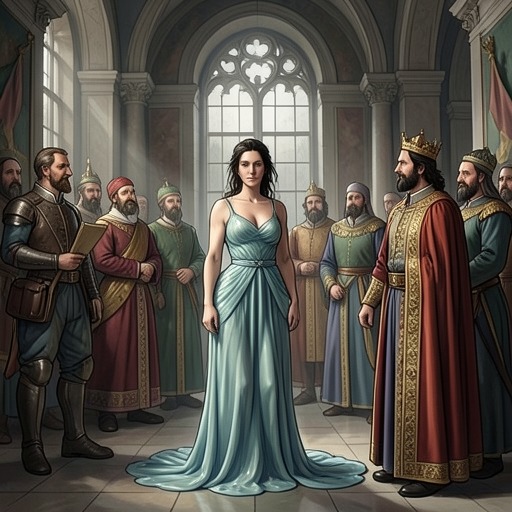
At the wharf, the court assembles as a ranked public body. Young noblemen dismount while their families leave their carriages; dukes, peers, duchesses, foreign princes, and courtiers arrange themselves to salute the King. The gathering is not an undifferentiated crowd: precedence determines its formation before the ceremony proceeds. Beside the royal carriage, Lucien de Barenton, Count de Chrétien directs six footmen to unroll a gold-and-scarlet silk rug so that Louis XIV will not have to cross the dirty wharf. The courtiers form a double line along the carpet. Their arrangement both honors the monarch and displays Lucien’s unusually close service to him, a position that makes other courtiers envious.
The setting sharpens the contrast between rank and personal style. Lucien wears a gold-embroidered blue coat, but his informal steinkirk scarf, short mustache, and military-style auburn perruke distinguish him from courtiers who follow the King’s fashion. His privileged standing allows him to appear outside the prevailing style without losing his place beside the royal carriage. The scene therefore presents precedence as more than a list of titles: access and favor shape how rank is performed, even while the ceremony preserves its formal structure.
Procession and Public Position
The procession turns that structure into movement. The King’s legitimate descendants take the place nearest him. The widowed Grand Dauphin proceeds first, followed by his sons, the dukes of Bourgogne, Anjou, and Berri. Madame asserts her family’s precedence by marching ahead of the Duke du Maine, his wife, and his brother, despite Louis XIV having declared those children legitimate. Her action shows that ceremony can be a means of contesting the very status it is supposed to settle: by insisting on her position in the line, she makes a claim about the relative standing of the families present.
The Marquise de Maintenon’s position likewise reveals the difference between private importance and public rank. Her carriers take her sedan chair aside so she can enter the procession in the correct place; in public, the King’s wife ranks only as a marquise. The pause gives ceremonial form to a politically significant limit. Her closeness to Louis XIV does not erase the category under which she is publicly placed, and the procession must accommodate that distinction rather than simply reflect intimacy.
When Monsieur and Madame, Chartres, Mademoiselle d’Orléans, Lotte, the Chevalier de Lorraine, and Marie-Josèphe de la Croix enter the procession, each joins a sequence governed by rank. Marie-Josèphe is the exception: Madame has given her a place, but she knows she is out of position. She feels both grateful and uneasy, particularly when she passes the Duchess du Maine, whose hostile glare registers the social cost of the breach. The episode makes precedence personal. For Marie-Josèphe, a place in the line is at once a favor, a source of exposure, and an obligation she cannot comfortably claim as her own.
Permission, Silence, and Conduct
Etiquette regulates not only where a person stands but what that person may do. When Louis XIV orders Yves de la Croix to wait until after Mass to begin his study, Marie-Josèphe wants to emerge from behind Lucien’s cloak and support her brother’s appeal: the carcass is already decomposing, and delay matters to the work. She nevertheless remains hidden. She understands that she has already breached etiquette and that she must not show herself to the King or speak unless he addresses her first. The protocol converts her judgment about the urgency of the study into silence: she sees a reason to intervene but considers herself barred from doing so.
The same constraint shapes a later moment of uncertainty. When Marie-Josèphe hears that Louis XIV is present and fears that Yves’s dissection must proceed, she worries that she may have failed to remind him of the appointed time. Yet although she is capable of performing the dissection, she recognizes that doing it herself would put her outside her proper place. She curtsies to Madame and Mademoiselle, then runs toward the tent entrance, thinking of asking a musketeer for help. Her competence does not automatically authorize action. Etiquette places a boundary between being able to do something and being entitled to do it, and Marie-Josèphe must seek an intermediary rather than simply take over.
The King’s Limits and Exceptions
The protocol also shapes encounters between rulers. When Louis XIV and Pope Innocent meet, both sides bow, but the King gives his hand only to the Emperor, described as the only man in Europe whose rank equals his. He does not make an exception for Pope Innocent, although he had done so for his deposed ally James of England. The comparison shows that even a meeting between sovereign and pope is staged through distinctions of rank, and that a gesture of recognition can be withheld as deliberately as it can be given.
Across these scenes, precedence functions as both ceremonial order and political language. It makes proximity to the King visible, marks the boundaries of legitimate public status, and provides a form through which family claims and royal favor become legible. Its rules can restrain Marie-Josèphe even when she has relevant knowledge, while a privileged courtier such as Lucien can stand close to the King despite ignoring fashionable conventions. The system is therefore neither a neutral arrangement nor a simple measure of personal worth: it is a public choreography in which position confers meaning, and departures from position carry consequences.